Glossary: Extended techniques
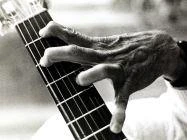
Luis Bonfa's hand, 1980. © Alberto Rizzo
Bonfá learned a traditional classical technique as a student of Uruguayan classical guitarist Isaias Savio. Shaped nails on the right hand fingers accounts for the polished sound of his playing, as well as the wide range of tone colors he was able to extract from the instrument. Interestingly, Bonfá seemed to generally play using the flesh of his thumb, rather than the nail, so as to allow greater contrast between the bass lines and the upper voices. Aside from being a skilled virtuoso, Bonfá was also a clever player. Many of his songs employ innovative techniques that are used to imitate the sound of other instruments. The techniques listed below are crucial for achieving the Bonfá sound. For further reference, see Brian Hodel’s interview with Bonfá, “Brazilian Wizard”, p. 22.
- Upright bass. (for Bonfabuloso, Night & day, Ahearing, George back in town, Blue Madrid, Lonely lament) As noted above, use the flesh of the right hand thumb instead of the nail when playing bass notes. This makes the guitar sound more like an upright bass playing a walking bass line, and gives the notes an overall softer sound. Note that this is not the same as pizzicato, where the string is muted with the palm of the right hand. This technique is especially important for the numbers with a rapidly moving bass line, as the contrasting timbre between the bass and the higher voices allows the melody and chords to stand out.
- Brushes. (for Boulevard, Manhã de carnaval, Sambolero (ed. Hodel), Feitiço da vila) Notes using this technique are marked ♪x. It is a type of muting of the strings. Angle the right hand almost parallel to the strings so that the fingers (i,m,a, all together) “swipe” over the 6 5 4 strings (i.e. the metallic ones) when struck. This imitates the swooshing sound of brushes on a snare drum. The tricky part with this technique is that it is mixed in with regular strokes, so the wrist needs to be on a swivel of sorts in order to alternate back and forth between angles in quick succession.
- Lush String Effect. (for Tenderly, Variations on Guitar, Adventures in Space) Angle the right hand over and parallel to the strings, and strum rapidly with a or m (like the back and forth motion of windshield wipers). As the name implies, this creates a shimmering sound, like a tremolo for multiple strings.
- Brazilian Percussion Instrument. (for Batucada, Carnival) Position palm of the left hand flat against strings with 5th finger near the XVI fret, while playing natural harmonics on the XII fret with the left hand 2nd finger. This is meant to recreate the sounds of percussion instruments such as the tamborim, ciuca, and frigideria which are often heard during the Brazilian Carnaval.
Misc. generic effects
- Tambora, percussion on guitar body (for Marajo, Indian dance). For the tambura, (lightly) whack the bridge of the guitar with the thumb. For general percussion, tap the guitar body with the left or right hand in various areas of the instrument body.
- Snare drums (for Marcha escosesa, Bagpipes) This is a classical guitar technique notably used in Tarrega’s (1852-1909) Gran Jota. For this technique, the 5th string is pulled under the 6th string, and both are held down with the i of the left hand near the IX or X fret. Hitting the notes results in a rattly snare-drum like sound, and rapid repeated strokes can sound like a snare drum roll.
Observations on recurring idiomatic musical material
In addition to the techniques that Bonfá frequently makes use of across different songs, one also notices when surveying these pieces instances where he reuses certain musical material that is highly idiomatic to the guitar. It's possible that some of this material formed the basis for some of his improvisations. Some examples of this are the mysteriously dissonant, Bernard Hermann- esque chords with the repeating B octaves in Murder/Reflections that make a reappearance in A Brazilian in New York and Adventures in space; the jazzy i7add9 bar chords in Night and day (Bonfá used bar chords frequently), Blue Madrid, Brazilian in New York, etc.; the diminished block chord that moves up and down the fingerboard in Murder, Fanfare, Mambolero, Adventure in space; the Fmaj7 and Gmaj7 chord with open 1st and 2nd strings followed by artificial harmonics at XII and XIX on 1st and 2nd strings (Tenderly, Adventure in space, etc.); the lushly spaced opening IMaj7th chords of Enchanted mirror/Mar encantada (which appears to have been a reworking of Enchanted mirror, hence the similar titles) and Ilha de coral. There are likely other recurring motifs to be found as well.
Back